

Warning: This story contains a reference to suicide.
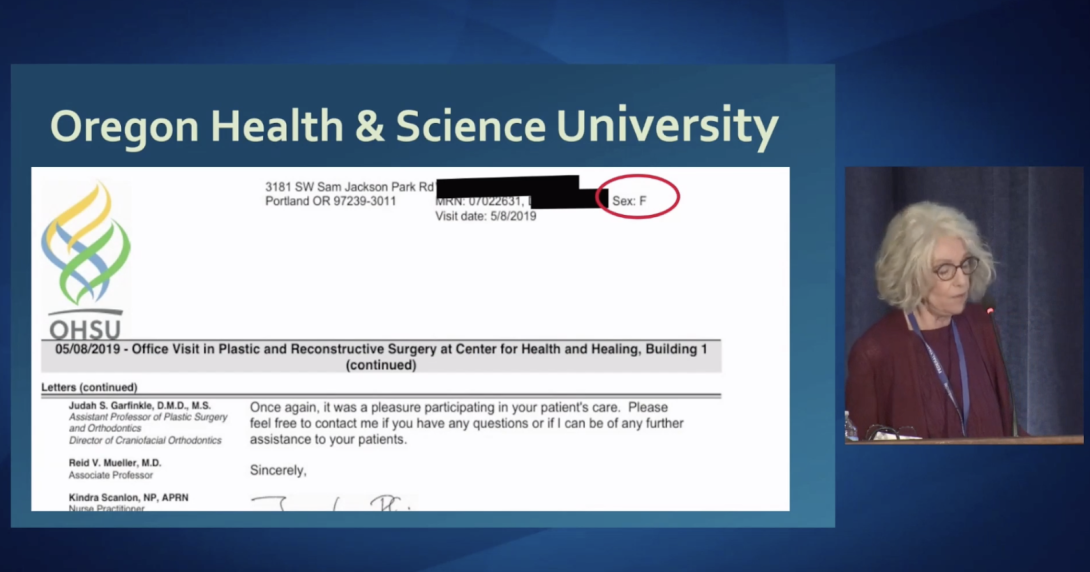
On July 9, Trump administration officials hosted a live-streamed seminar that portrayed gender-affirming care as “fraud” that should be civilly prosecuted, while citing examples from organizations representing two of Oregon’s three biggest providers — Oregon Health & Science University and Kaiser Permanente — to make their case.
To show examples of deceptive practices, medical records of OHSU and Kaiser patients were even displayed on screen.
It was just the latest in a series of events that have patients and providers in Oregon grappling with a reality that a year ago seemed unthinkable — including the threat of lawsuits, civil penalties and even criminal prosecution for those providing gender-affirming care.
The seminar naming OHSU and Kaiser was hosted by an agency that frequently sues hospitals and health insurers, the Federal Trade Commission. And while gender-affirming care has long been polarizing, the new threat of federal investigations is taking a very human toll in Oregon and other states..
“Terror.” said Julia Przedworski, an Oregon LGBTQ+ health equity researcher and advocate who identifies as queer, trans and nonbinary. Summing up the atmosphere in the local LGBTQ+ community, they said, “There is a lot of fear — personal existential fear and this broader community-wide hopelessness.”
Local providers have been inundated by “panicked messages from patients and clients fearing for their safety, and scared about whether the government could access their medical records,” a senior executive at one Portland-area facility that provides gender affirming care services told The Lund Report. They said the impact was evident from the moment executive orders targeting gender-affirming care began rolling out in January.
“Some people became suicidal,” said the executive, who asked to remain anonymous citing concern over reprisals. “This is a marginalized population that is already at high risk for experiencing trauma in health care settings,” they said, adding that many on staff at their facility are transgender and nonbinary, and experiencing the same pressures as their patients and clients.
“We are in this bizarre place of carrying on as usual while constantly bracing for the next shoe to drop,” they said. “It’s horrific.”
Already, dozens of subpoenas have been sent by the Department of Justice to a variety of providers across the country, and tensions that were already evident in February are growing.
But even as Oregon health care providers are under federal pressure to end transgender care services, state law requires they continue. Oregon state law protects access to medically needed care to all populations, including care specific to the LGBTQ+ community.
That puts health care providers, including major players such as OHSU and Kaiser Permanente, in a difficult spot.
Following Oregon statute as required — and serving patients as they believe is the right thing to do — could open them up to not only losing funds, but also civil lawsuits or even criminal prosecution by the federal government.
As a result of the executive orders issued by the Trump administration, several hospitals in other states have already announced they would stop or scale back gender affirming care for patients under age 19. Children’s National Hospital In Washington, D.C., stopped prescribing puberty blockers and hormone therapy as a result of the directives.
California has similar statewide protections for gender affirming care as Oregon, yet the Children’s Hospital Los Angeles, touted as the nation’s biggest public provider of gender affirming care for youth, announced it will close its Center for Transyouth Health and Development July 22.
In Oregon, no such decisions have been announced. But health systems’ leaders have been wrestling with what to do next.
“The growing division between federal and state policy toward approaches to gender-affirming care has created a challenging, stressful situation for our patients seeking care, as well as for our clinicians whose mission it is to care for them,” a Kaiser Permanente spokesperson said in a written statement to The Lund Report.
Representatives at Kaiser and OHSU said they would continue to provide gender care services and adhere to state laws that protect access to care for all populations.
A spokesperson with OHSU — the Pacific Northwest’s largest transgender care provider — told The Lund Report that the hospital continues to provide the full spectrum of gender-affirming care, including primary care, behavioral health services, hormone therapy and surgery, following evidence-based medical standards, “in compliance with state and federal laws.”
But neither responded to questions about the threats the recent federal directives pose to their services. A spokesperson with Kaiser did say that the company has not received any inquiries from the FTC or any other federal agencies concerning their gender affirming care.
Legacy Health, which also offers gender care services in Oregon, declined to comment on the issue.
If the administration succeeds in its efforts, the loss of transgender care would be devastating, said Seth Johnstone, transgender justice program manager with the advocacy group Basic Rights Oregon. Johnstone said that every time another memo or executive order is released even people who are accustomed to anti-LGBTQ+ rhetoric are now struggling with fear and anxiety over losing their health care.
“Folks are panicking and wondering whether or not they should leave the country, and parents are wondering what's coming next,” Johnstone said. “Folks want to know, is this going to change my Medicaid coverage tomorrow, or can I still go see my doctor next week? Folks are reaching out with that panic.”
What gender affirming care means
Gender-affirming care is often considered life-saving care, particularly for youth. According to the Centers for Disease Control, lesbian, gay, and bisexual students are about four times more likely to have attempted suicide than their heterosexual peers.
While experts, including in Oregon, differ on the extent to which traditional standards of evidence and efficacy should apply to an area of care that’s still relatively new, research has indicated that gender-affirming care can improve the mental health and overall well-being of gender diverse children and adolescents, significantly reducing depression and suicidality.
Gender affirming care spans a variety of nonsurgical and surgical procedures, from hair removal and hormone therapy to facial, breast and genital augmentation — procedures not necessarily exclusive to the transgender patients, but used to align outward, physical traits to a person’s gender identity. It also includes mental health care. Gender affirming surgeries are very rarely performed on people under 18, and nearly all of those are chest surgeries.
In 2023, Oregon passed a law expanding the range of gender affirming treatments that insurers must cover when a provider deems them medically necessary.
Meanwhile, the U.S. Department Health and Human Services has rewritten national standards on what gender care means. With anonymous authors and without peer review, the “Treatment for Pediatric Gender Dysphoria: Review of Evidence and Best Practices,” released in May, has been panned by medical groups, including the American Academy of Pediatrics, for inaccuracies and misrepresentations. The HHS guidelines stress psychotherapy over physical treatment for gender dysphoria, which LGBTQ+ advocates view as an implicit endorsement of so-called “conversion therapy”, a controversial and discredited response to gender dysphoria.
A drumbeat of hostile actions
Immediately upon taking office, President Trump began issuing a series of executive orders and other actions dismantling health care protections for LGBTQ+ people:
- He decreed that the United States will only “recognize two sexes, male and female,” and that they are not changeable.
- The administration banned federal funds from being used for “gender ideology,” a new, ambiguous term from the administration that put health care providers on notice that they could lose federal funding for serving the LGBTQ+ community.
- Another executive order prohibited surgeries or other transition procedures for transgender youth, and threatened to cut off research and education grants for medical schools and hospitals that continued providing gender affirming care.
- In March, the Centers for Medicare & Medicaid Services released a plan to limit insurers ability to cover gender affirming care.
The administration’s campaign now includes not just the FBI, but the Federal Trade Commission, using tactics that mirror the federal pursuit of pharmaceutical company wrongdoing over the last two decades.
The trade commission’s July 9 seminar singled out terminology it considered fraudulent, including “nonbinary.”
The FTC has broad investigative authority, including conducting non-public investigations and issuing subpoenas, and it can share information with federal prosecutors.
Speaking at the FTC event, DOJ Chief of Staff Chad Mizelle said the DOJ has launched investigations into drug manufacturers, clinics, hospitals and other providers who offer transition-related services, alleging such violations as health care fraud, which could result in civil or criminal prosecution. He would not name the institutions under investigation.
The FBI has also posted on social media that gender affirming care was akin to “mutilation” and urged the public to “report tips of any hospitals, clinics, or practitioners performing these surgical procedures on children.”
Przedworski said the administration’s actions mean that, in addition to losing access to medically necessary care, people are increasingly becoming targets of discrimination and assault — their very existence “erased and vilified by the federal government.” This is happening to a population who, compared to non-LGBTQ+ folks, already experiences higher rates of mental health issues, greater poverty and a higher dependency on Medicaid, they said.
Przedworski said that there is also a lot of resilience within the LGBTQ+ community. “We have a long history of surviving and thriving in a world that is hostile to our very existence.”
While Oregon is one of the better states for transgender people, Przedworski is concerned about the compromises that will be made to appease the administration's demands. “We’re hopeful, but we don’t feel confident,” they said. “There’s this crushing sense that all the progress that we’ve made in the last decade and a half or so has disappeared in the course of months.
Oregon’s powers unclear
Oregon has joined other states in suing the administration for withholding federal funds over gender affirming care.
Oregon Attorney General Dan Rayfield told The Lund Report in an email that his staff is actively working with health care providers and institutions to ensure they understand their rights under Oregon law. Regarding his agency efforts to protect those who resist federal pressures and face investigation or lawsuits, his office offers a gender-affirming care toolkit that includes links to the state's shield law protecting access to that care, along with guidance for providers and patients.
“These are deeply personal medical decisions that should be made between providers and their patients — informed by medical science and research, not dictated by shifting federal politics or threats to funding. We’ll continue to stand with our providers to ensure Oregon is a place where they can deliver the care their patients need.”
If you or someone you know is struggling with thoughts of suicide or a mental health crisis, call or text 988 for free, immediate support.