
This article has been updated to incorporate additional reporting.
Two years after Oregon Health & Science University leaders laid off hundreds of employees and announced a “strategic alignment” to curb losses and focus on providing profitable types of complex care, the strategy is succeeding — boosting the institution into the black for the first time in years. But some providers say they fear the pendulum has swung too far.
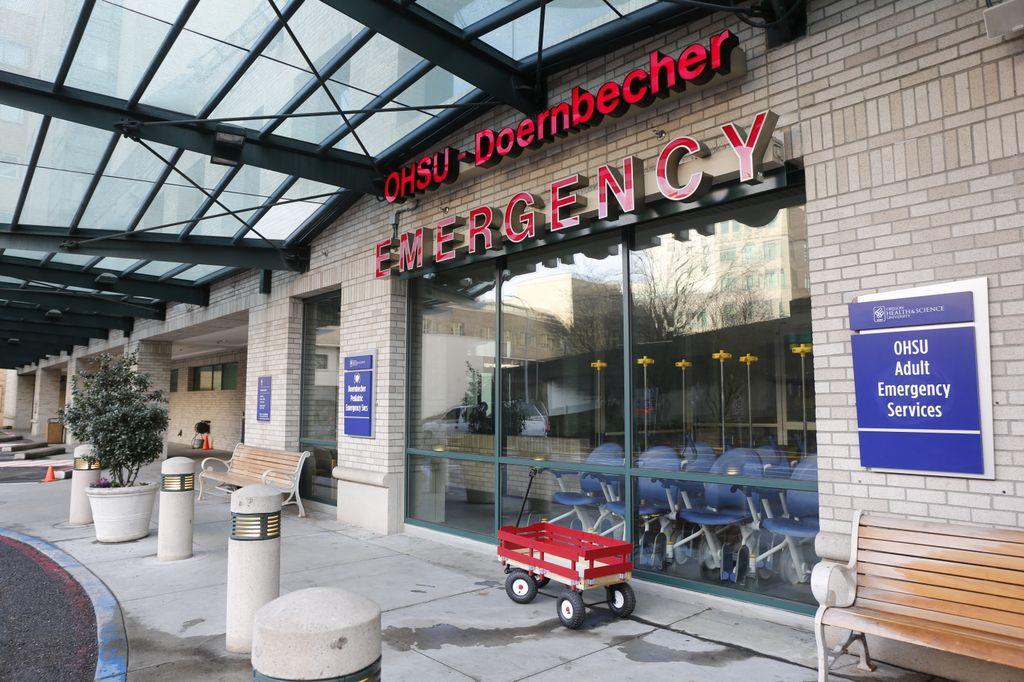
Emergency department nurses are now going public to say university leaders’ shift in priorities is affecting how they can serve patients. Nurses say they've seen two years of deteriorating conditions for working, teaching and care in a department that for many patients is the front door of OHSU.
That comes on top of similar concerns that have been raised by others, such as champions of the university’s family medicine department.
Duncan Zevetski, an oncology nurse and shift supervisor at OHSU, spoke to The Lund Report as part of an effort by the Oregon Nurses Association to raise awareness about declining conditions in OHSU’s emergency department. He says the new strategy is at least partially responsible for what nurses have seen.
“Part of their financial strategy has been to become a ‘destination hospital’ for these high-reimbursement specialties,” he said, citing oncology and other specialties. While such care is vital to Oregonians, “that really leaves not a lot of room for other folks — for the rest of Oregon, right?” he told The Lund Report. While cancer care and other specialties are clearly crucial to Oregonians, he added, “They've hyper-prioritized these specialties.”
The situation shows how OHSU leaders are wrestling with challenging financial dynamics, trying to become a top cancer care center while preserving its status as a research engine and a major employer, while attending to Oregonians' needs.
While hospitals have long competed for patients with better-reimbursed commercial health insurance, more recently they have also been competing for patients that need complex or specialty care, motivated by reimbursements that offer the highest return on investment.
And as an academic medical center, or teaching hospital — and one that has long prioritized research — the financial pressures on OHSU are in some ways more daunting than at other types of hospitals, thanks to federal funding cuts and a push to shut down its primate center. Closing it could increase the institution's costs if the federal government doesn't chip in.
With limited beds and a small system of partner hospitals, OHSU leaders have stepped up their efforts to compete with other health systems for patients who need types of care that are profitable, while positioning the university as the leader in those areas of care.
Among other things, OHSU has set up what it calls a “mission control” center intended to shift patient to fill beds in the most efficient way possible. To OHSU leaders, the best use of beds means reserving beds for complex care patients at the facility they say is best-equipped to provide that care — OHSU.
“It’s really not about any one complex patient or another being more desirable than another, but rather making sure that the complex patients who are coming into OHSU — or, rather, the patients who are coming into OHSU who are more in need of specific services that we have available to provide — are able to have access to those beds,” said Renee Edwards, OHSU’s chief medical officer.
As for other individual patients in need of non-complex care, it's not about whether they have insurance coverage or profit potential, she told The Lund Report: “If their care is appropriate at another hospital, then that's okay — they can get care at those other hospitals, which allows us to preserve the capacity for the most complex patients at OHSU.”
She said OHSU leadership is trying to balance competing priorities with limited capacity.
“It is about understanding the needs of Oregonians and where they can go to get [complex and specialty] care,” Edwards said. “Because if they can't get a bed at OHSU because our hospital is full, then their only other choice is to be transferred all the way to Seattle or all the way to San Francisco, and that distance can make the difference between life and death, or between the development of serious complications.”
Other health systems in Oregon contend they also provide top-quality care, however. PeaceHealth, St. Charles, Legacy and Providence, among others, have also heavily marketed their specialty care, including for cancer.
“OHSU fulfills a very important role in the state as it relates to education and research and clinical care,” said Dr. Dan Oseran, chief medical officer for specialty care at Providence Oregon, in an emailed statement. “Having said that, it is important to recognize that cutting edge subspecialty care, technology and research have also long been part of the services delivered by Providence, particularly through our Heart, Cancer and Neurosciences Institutes.”
Access to OHSU care varies, nurses say
Christoper Kish, a charge nurse in the OHSU Emergency Department, said the push to reserve beds for more profitable types of patients hurts the access and quality of care delivered to other patients who show up at OHSU at their times of need. Like Zevetski, he spoke as a member of the Oregon Nurses Association.
Kish told The Lund Report he’s seen a shift in how patients who come to the emergency department get access to care and follow-up in an inpatient rooms. It’s become “we're going to prioritize our people receiving cancer care to get inpatient rooms over somebody coming in for respiratory distress that's not cancer-related, for example, or people coming in for higher-dollar surgeries that make the university a lot of money,” he said.
Those more profitable patients, he added, “get brought into rooms, or they get prioritized into rooms before somebody who may have had a two-week post surgical infection that presents to the emergency department. So we've definitely seen a change in who is getting rooms in the hospital.”
The challenge is exacerbated by the OHSU emergency department’s small amount of beds and by a statewide issue of hospitals being required to “board” or house patients that don’t actually need hospital care or generate much for them in the way of revenue — but don’t have access to other facilities that could offer low-level care, and cannot be discharged under federal law.
However, some of the patients being housed in the emergency department do need care, just not a complex or specialty kind, Kish said. He and his fellow charge nurses, who act as shift supervisors in charge of patient care, are “seeing patient after patient get bypassed because they're not one of those specialty level-of-care patients,” he added.
And the result is providing a lower level of care, with many patients housed in the hallway for care, sometimes for days or more. This is contributing to not just burnout, but moral injury — where providers must deal with the trauma of providing care they know is inadequate, Kish and Zevetski said.
Edwards, the university’s chief medical officer, agreed that the situation is problematic, but she defended the care being delivered as excellent — even if it is happening in a hallway.
“We completely agree with the fact that the situation in our emergency department is urgent,” she said. Staff members’ moral distress is real, and “we feel that same situation, and we're absolutely committed to continuing the work we've been doing to work with our frontline clinicians to address the problem, and really to address the problem for patient hospital beds across the state,” she said.
She added, “The piece that I would perhaps disagree with a little bit is that our teams are doing a beautiful job of supplying care for those patients in our ED despite the difficulty of the situation. Now, is it ever desirable to have an ED patient in a hallway bed, as opposed to in a hospital bed? Of course not” But, she added, “it's not less care.”
Strategy is working, financially
As a 2023 study in the Journal of Hospital Medicine put it, academic medical centers are increasingly wrestling with how to balance competing demands between their community’s medical needs and the complex care that contributes more to the hospital’s finances.
So OHSU is hardly the only academic medical center pursing a complex-care strategy.
But one thing is clear: it's succeeding. OHSU’s focus on specialty care has led to a steady increase in what’s known as the “case-mix index” measuring what portion of patients are receiving complex care. That is a big part of what’s driving the university’s improved finances, President Shereef Elnahal told the OHSU board on Friday.
Of all the country’s more than 200 academic hospitals, OHSU appears to be doing a higher proportion of complex care than just about anyone, judging by Elnahal’s presentation.
“We are clearly in the top five to 10 academic institutions in the United States for the complexity of conditions that patients come to us with,” he said.
OHSU’s case-mix index measuring the complexity of care provided now stands at 2.68, according to Elnahal. That’s up from 2.48 two years ago and 2.30 six years ago, records show.
Unlike many teaching hospitals, OHSU has a public mission
Unlike some teaching hospitals, OHSU is publicly owned. It formerly was a state agency and remains a public corporation, one that was granted semi-independence to pursue its public-service mission by the Oregon Legislature in 1995.
It remains governed by a board whose members are appointed by the governor. Gov. Tina Kotek has not hesitated to indicate to them both publicly and privately that, to her mind, they work for her.
Longtime OHSU observers have expressed concern that the university leadership’s push for financial stability may be undermining its longstanding priorities, including health care provider education, serving lower-income Oregonians and fostering family medicine and general practitioners to tend to the state’s residents.
Kish shares that concern.
“OHSU is also this very unique entity,” he said. “We're supposed to take care of everybody … We're not just the OHSU Cancer Institute. We're not the OHSU Cardiac Institute. We're OHSU hospital — Oregon Health Science University. We're supposed to be able to take care of anybody coming in, and provide them with the best care, that they deserve. And it seems we are veering from that now in focusing on, ‘We want to provide you with the best care you deserve, as long as you're in one of these specialties. Otherwise we want to send you someplace else to receive care.’”
OHSU leaders, however, dispute that characterization. They insist that, contrary to nurses' perception, people who need to be admitted to the hospital are — based solely on clinical need. "Admissions decisions and placements into inpatient units at OHSU are based on clinical need alone, full stop," said a statement emailed by an OHSU spokesperson.
At Friday’s OHSU board meeting, after several emergency nurses raised concerns, Elnahal said the nurses had good ideas and OHSU leadership was intent upon working with them to make change and address conditions in the emergency department that he agreed were not acceptable. Among other things, the nurses are pressing OHSU leadership to do more to ease overcrowding by transferring patients to other local hospitals.
After the meeting, Zevetski said Elnahal’s comments were good to hear, but he wished the commitments had come sooner. He attributed the administration’s response to increasing media coverage. The coverage was driven in part on the recent firing of OHSU CEO Tareek Salaway, whose lawyer told reporters he’d raised concerns about the emergency room situation.
“I'll be frank,” Zevetski said. “Our nurses have been raising the alarm on the emergency department for greater than two years at this point. And It seemed like [OHSU leaders] weren't too willing to take too many steps on it until they started getting some media attention about it. So I think we lit a fire under that, which is good.”